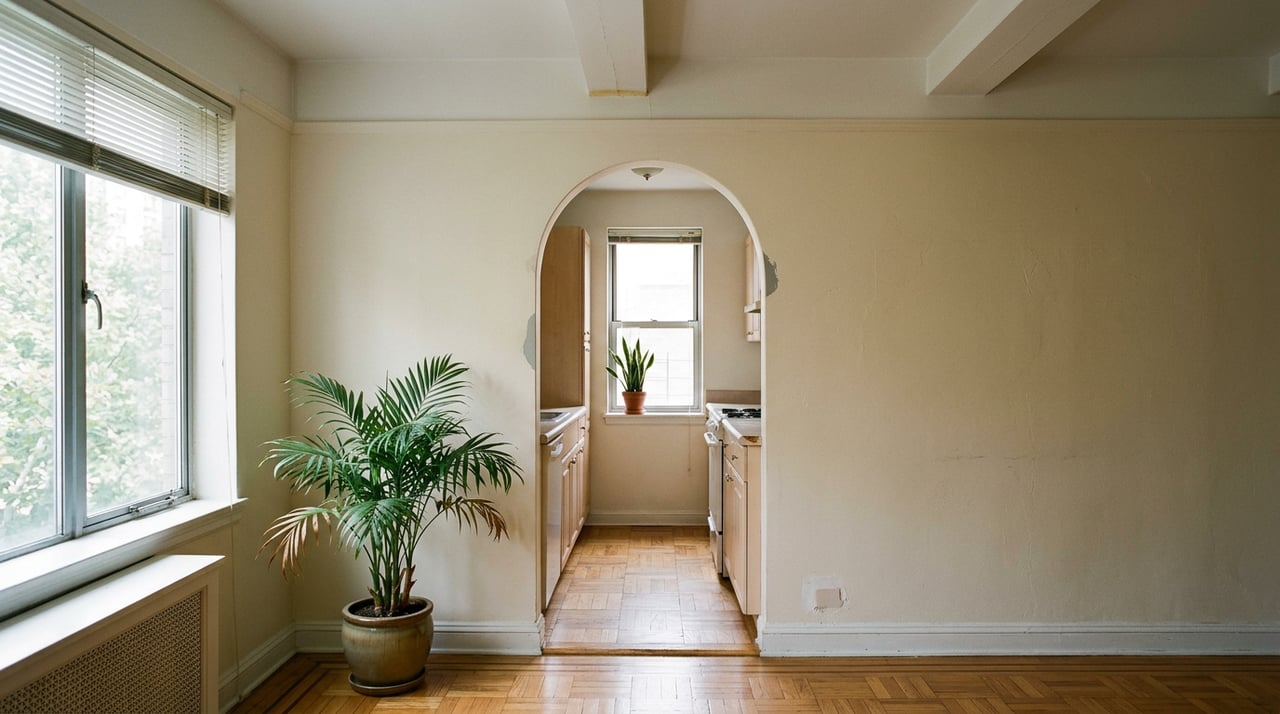
A recently sold unit at One Essex Crossing on Broome Street closed at an average of $1,861 per square foot. A prewar co-op two blocks away at 530 Grand Street closed its most recent sales at $737 per square foot. Both buildings sit inside the same zip code, the same school district, the same subway walk to the Delancey St-Essex St station. Quote a single "Lower East Side median" to a buyer comparing this neighborhood to the next one over, and you've told them almost nothing about either building.
That gap is not a fluke of one listing or one lucky closing. It's the shape of the market itself. The Lower East Side isn't one housing market wearing a single price tag. It's three, stacked on top of each other, and the blended number that shows up in a market report is only useful if you know which of the three it's actually describing.
The Number Nobody Interrogates
Monthly price data for this neighborhood swings hard enough to look almost random. In January 2026, PropertyShark recorded a median condo sale price of $875,000 on the Lower East Side, down 43.1 percent year over year, while the median co-op sale price came in at $755,000, up 23.8 percent year over year, on a total of just 12 closed sales for the month. Read those two numbers side by side and the neighborhood looks like it's simultaneously collapsing and booming.
It's neither. With a transaction count that small, one or two closings at a luxury tower or one or two closings at a legacy co-op complex can swing the "median" by double digits without any actual shift in what things are worth. The monthly number isn't measuring appreciation or depreciation. It's measuring which tier happened to trade that month.
Three Buildings, Three Markets
Walk the blocks around Delancey and Essex and you can see the three tiers standing next to each other.
The oldest tier is Co-op Village, the cluster of midcentury cooperative towers built by labor unions along Grand Street starting in the late 1940s and 1950s. Seward Park, Hillman Houses, Amalgamated, and East River Houses were all designed with input from architect Herman J. Jessor, who over his career worked on more than 40,000 units of cooperative housing across the city. These buildings were built for affordability and space, not for board approval as a scarcity filter, and their price per square foot still reflects that mission.
The newest tier is Essex Crossing, the mixed-use development that replaced decades of vacant parking lots at the former Seward Park Urban Renewal Area. One Essex Crossing at 202 Broome Street, designed by CetraRuddy, anchors the for-sale side of that project, alongside rental buildings like The Essex, the development's tallest tower, and The Rollins, named for jazz saxophonist Sonny Rollins, who once lived on the site.
Between those two sits the neighborhood's original walk-up housing stock, the five- and six-story tenement buildings that predate both. A fifth-floor walk-up in one of these buildings can list in the mid-$400,000s at the same time a glass-walled condo two blocks away asks $2.5 million, a spread that shows up regularly enough on the Lower East Side that agents who work the neighborhood treat it as routine rather than remarkable.
Here's what recent sales activity looks like across the three tiers:
| Housing tier | Example buildings | Recent closed price per square foot |
|---|---|---|
| Postwar limited-equity co-op | Seward Park (417 Grand Street), Hillman Coop (500 Grand Street) | $821 to $1,129 |
| Prewar co-op | Hillman Coop (530 Grand Street, built 1939) | $737 |
| New construction condo | One Essex Crossing (202 Broome Street) | $1,861 |
Notice something else in that data: at Seward Park, recent closed sales averaged $1,129 per square foot, above the building's current asking average of $1,012. At One Essex Crossing, it runs the other way, with a current asking average of $2,062 sitting above the $1,861 that recent sales actually closed at. These aren't two points on the same price curve moving in tandem. They're two separate markets with their own supply, their own negotiating dynamics, and their own timing.
Why These Tiers Don't Compete for the Same Buyer
The price gap holds because these buildings aren't actually competing against each other for the same buyer.
A purchase at Hillman Coop or Seward Park runs through a co-op board, and board policy varies building to building even within the same four-complex cluster. At 500 Grand Street, the building permits co-purchasing, pied-à-terre ownership, and gifting, and allows subletting after two years of ownership. That's a very different transaction, with a very different buyer profile in mind, than a condo purchase at One Essex Crossing, which carries no board approval process at all and closes on a financing timeline that a co-op board simply doesn't allow.
That structural difference sorts buyers before price ever enters the conversation. Someone who needs speed, cash flexibility, or the option to rent the unit out gravitates toward the condo tier. Someone prioritizing space and a lower carrying cost, and willing to sit through a board package, gravitates toward Grand Street. The walk-up tenement stock captures a third buyer entirely, someone trading the elevator and the amenities for the lowest entry price the neighborhood offers.
The Pied-à-Terre Tax Just Made the Split Structural
A new state tax landed on July 1, 2026, and it's going to widen this gap rather than close it.
New York's pied-à-terre tax, formally Tax Law Article 30-C, applies an annual surcharge of 4 to 6.5 percent to non-primary condos and co-ops valued at $1 million or more, with the surcharge scaling up as the sales price of comparable property increases. Owner-occupied primary residences are exempt, along with unsold sponsor units. The law was signed May 28, 2026, and runs through 2031.
On paper, the tax targets trophy apartments across Manhattan. On the Lower East Side specifically, it lands almost entirely on one tier. Every one- and two-bedroom unit at One Essex Crossing prices well above the $1 million threshold, based on published unit estimates ranging from roughly $1.3 million for a one-bedroom up past $2.8 million for a two-bedroom. A non-primary buyer closing there now carries a real, ongoing cost that didn't exist a year ago.
Grand Street's co-op stock mostly sidesteps that exposure, not because of any board rule, but because of unit size and price per square foot. A studio running 500 to 650 square feet at $800 to $1,100 per foot lands well under $1 million regardless of who's buying it or how they plan to use it. A tax designed to catch pieds-à-terre borough-wide ends up, in this specific neighborhood, functioning as a tax on one product type: the new-construction condo tower.
What Essex Crossing Is Still Building, and What Grand Street Isn't
The capital flowing into this neighborhood right now is also concentrated, not spread evenly across it.
- Delancey Street Associates, the developer behind Essex Crossing, expects to start construction in 2026 on a 99-unit mixed-income building at Site 9, the former home of Essex Street Market, which will push the full development toward roughly 1,100 total units, including 550 permanently affordable homes.
- The Delancey St-Essex St subway complex is getting an accessibility overhaul, funded in part by congestion relief zone revenue, following an agreement between the MTA, the New York City Economic Development Corporation, and Delancey Street Associates.
- A new cultural venue called Canyon was announced for Essex Crossing in mid-2025 and is expected to open sometime in 2026.
Every one of those projects sits inside the same handful of blocks bounded by Delancey, Essex, Broome, and Grand streets. None of it touches the co-op towers a short walk away. If public and private investment keeps concentrating in that corridor, the price appreciation it produces is likely to show up there first, not as a lift across the whole Lower East Side median.
What This Means If You're Comparing Neighborhoods
- Before you compare a Lower East Side price point to another neighborhood's, ask which tier that number is drawn from. A co-op figure and a new-construction figure answer completely different questions.
- If you're evaluating an Essex Crossing purchase as a non-primary residence, build the pied-à-terre surcharge into your monthly carrying cost projection, not just your closing budget.
- If you're looking at Grand Street's co-op towers, ask about that specific building's subletting, financing, and pied-à-terre policies. Co-op Village is four separate complexes, not one uniform building.
- Budget for a longer runway on the co-op tier. Board packages add real weeks to a closing timeline that a condo purchase doesn't carry.
FAQ
Is the Lower East Side's median home price rising or falling in 2026? It depends almost entirely on which tier's closings dominated that particular month. With as few as a dozen sales recorded neighborhood-wide in a single month, one luxury closing or one co-op closing can swing the reported median by double digits without reflecting any real shift in value.
Does the pied-à-terre tax apply to renters at buildings like The Essex or The Rollins? No. The Essex and The Rollins are rental buildings within Essex Crossing. The surcharge applies only to owned condos and co-ops valued at $1 million or more that are not the owner's primary residence.
Are all four Co-op Village complexes on Grand Street priced and governed the same way? No. Seward Park, Hillman Houses, Amalgamated, and East River Houses are separate cooperative corporations, each with its own board, its own subletting and financing rules, and its own sales history. Treat them as four distinct buildings when comparing price or process, not one interchangeable block.
If you're trying to figure out which of these tiers actually fits your budget, your timeline, and your plans for the unit, that's a conversation worth having before you start touring. Ryan Siciliano works the Lower East Side and the rest of Downtown Manhattan daily, and can walk you through what a given building's numbers actually mean before you anchor to a median that isn't describing the apartment in front of you. Let's Connect.