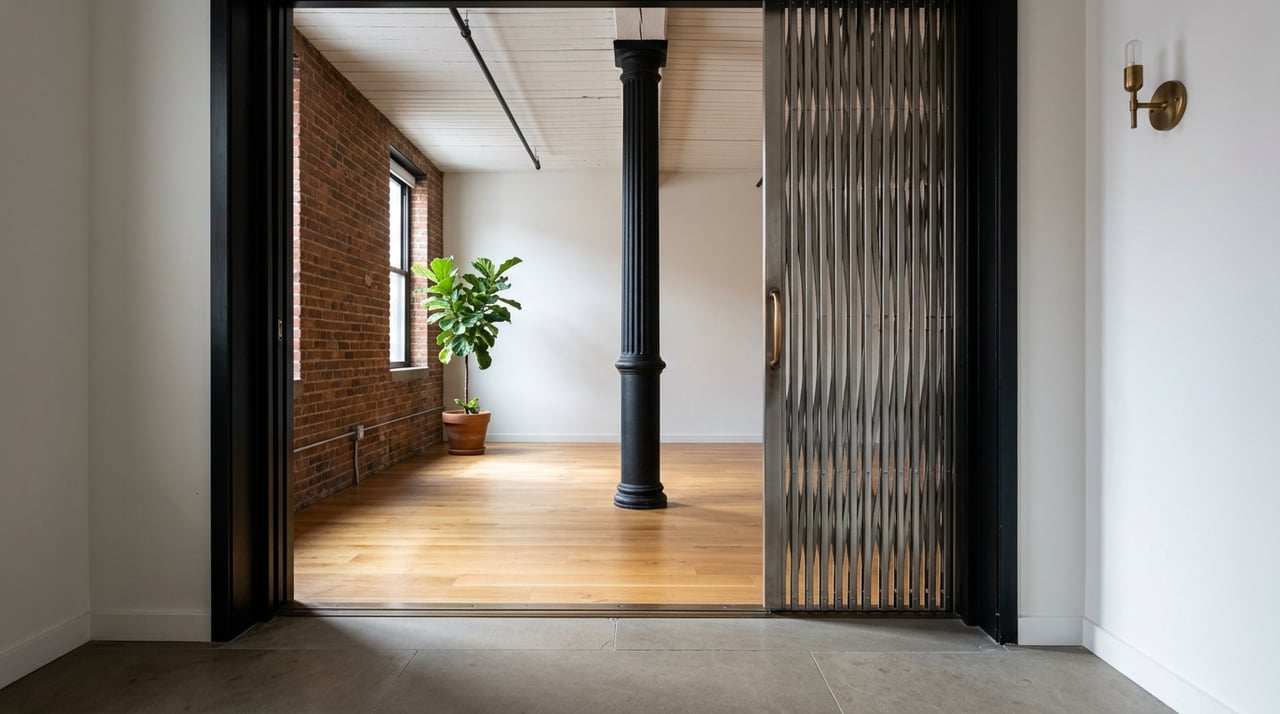
You sign the contract on a 2,200 square foot Broome Street loft with 13 foot ceilings and cast iron columns. Your attorney flags the Certificate of Occupancy. It reads Use Group 17D. You are not a certified artist. Under city zoning, you cannot lawfully move in on closing day.
That is not a hypothetical, and it is not the kind of surprise a floor plan or a comp set will surface. In Soho, the legal category of the loft is the single variable that decides whether you can occupy, whether your lender funds, and whether your resale audience shrinks to a subset of buyers. Finishes are cosmetic. Category is structural.
Three Legal Statuses Hiding Behind One Cast-Iron Facade
Two lofts on the same block, both listed as three-bedroom conversions, can sit in completely different regulatory frameworks. In Soho, a loft may be a legal residential unit, a Joint Living-Work Quarters for Artists unit, or an Interim Multiple Dwelling covered by the Loft Law. Those categories are not interchangeable.
- Market-rate residential. A final residential Certificate of Occupancy is on file. Occupancy is unrestricted. Financing behaves normally.
- JLWQA (Use Group 17D). Codified under Use Group 17D of the New York City Zoning Resolution, this classification allowed artists to legally reside in converted manufacturing lofts, provided buildings were brought into compliance with residential code requirements. To legally occupy a JLWQA loft, an individual must generally obtain artist certification through the New York City Department of Cultural Affairs.
- Loft Law IMD. A former commercial or manufacturing space in the middle of a legalization process overseen by the NYC Loft Board. IMD units that have completed the Loft Law process by obtaining a final certificate of occupancy may continue in perpetuity to be occupied as residential use without a DCLA artist certification.
The middle category is where the money leaks. A non-artist buyer who closes on an unconverted JLWQA unit inherits an occupancy violation the day the deed records.
What the January 13, 2026 Ruling Actually Locked In
On Dec. 15, 2021, the City Council approved the SoHo/NoHo Neighborhood Plan amending the NYC Zoning Resolution. The Plan created the Special SoHo-Noho Mixed Use District (SNX) and includes changes to the use of Joint Living-Work Quarters for Artists in this newly created special district. The Plan also includes a voluntary path to convert existing conforming JLWQA use to residential use while supporting the arts.
The price of that voluntary path was contested for four years. That Arts Fund fee, which starts at $100 per square foot and is indexed, was upheld by New York's highest court on January 13, 2026.
For a buyer, the ruling changed the strategic posture of every JLWQA seller in the district. The fee is no longer a litigation risk that might vanish. It is a permanent line item that a rational buyer will price into the offer. If the seller has not paid it, the buyer will.
The Arts Fund Math on a Typical Loft
The fee is stated per square foot, indexed, and non-refundable. Applied to the volumes Soho buyers actually shop, the numbers stop feeling abstract.
| Interior sf | Arts Fund at $100/sf (floor) |
|---|---|
| 1,400 | $140,000 |
| 2,000 | $200,000 |
| 2,800 | $280,000 |
| 3,600 | $360,000 |
That figure sits on top of code-related work required to bring the unit up to standard residential status and the eventual issuance of a new Certificate of Occupancy. DOB says it generally involves certification by the City Planning Commission chair, a one-time non-refundable contribution to the SoHo-NoHo Arts Fund, code-related work as needed, and issuance of a DOB certificate of occupancy. The good news is that this can be handled unit by unit rather than requiring a building-wide conversion.
The city's official guidance on the process lives at the NYC Department of Buildings JLWQA conversion page.
Where Financing Breaks Down
Lenders underwrite the certificate, not the listing photos. A unit whose CO still reads 17D is not a residential asset in the eyes of most large banks, and a Temporary CO or a building mid-legalization introduces conditions a portfolio underwriter may not accept without additional documentation.
The Loft Law path adds its own friction. Financing can be more complex in Loft Law structures. Some lenders require proof of progress in the legalization process. Resale timelines may shift if future buyers also need clarity around compliance steps.
The practical read: get the CO and any open DOB jobs pulled before your inspection contingency runs. If the file shows anything other than a clean residential CO, your loan officer needs to see it in writing, and your attorney needs to price the remediation into the contract.
The LPC Layer You Inherit at Closing
Most of Soho sits inside the SoHo-Cast Iron Historic District. That designation is what preserves the streetscape you paid to live on, and it is also what determines how long any exterior change will take.
Storefront changes, window replacements, rooftop additions, and visible façade repairs usually require LPC review, ranging from staff approvals to a public hearing. Staff-level approvals for straightforward work move in days to weeks. A Certificate of Appropriateness that triggers a public hearing can take months, particularly if the community board weighs in first.
The LPC calendar matters most when the loft you want has a rooftop bulkhead a prior owner never finished, a replacement window package sitting in a filed permit, or a storefront alteration on the ground floor that affects the residential CO above.
A Pre-Contract Due-Diligence Sequence
Before you sign, in this order:
- Pull the current CO and any Temporary CO. Confirm whether the residential status is final or in progress.
- Confirm the unit's legal category. If JLWQA, ask directly whether the seller has begun the conversion and paid any portion of the Arts Fund contribution.
- For any building described as a former manufacturing loft, verify Loft Board status and whether an IMD registration number exists. Buildings whose owners have filed for IMD registration with the Loft Board and received an IMD registration number are covered by the Loft Law.
- Check DOB NOW for open jobs, violations, and pending applications on the building and the unit.
- Ask the managing agent or sponsor whether the offering plan permits your intended use, including any rental strategy.
- Have your lender review the CO before the mortgage contingency deadline, not after.
- Read the last twenty-four months of board minutes for pending legalization work, LPC applications, and Local Law 11 facade obligations.
Each step corresponds to a specific number that could show up on your closing statement or your first-year operating budget. None of them are visible on the listing.
What the 1Q 2026 Numbers Say About Your Downside
Soho pricing has held. Redfin reports a median sale price of $3.2 million in March 2026, up 4.2 percent year over year. Rental demand is above the borough baseline. StreetEasy reports a median base rent of $5,995 in SoHo, compared with Manhattan's median rent of $4,695 in 1Q 2026.
The macro is supportive. Miller Samuel's 1Q 2026 reports show a Manhattan median rent of $4,695 and a co-op and condo median sale price of $1.225 million, with listing inventory down 16.7%. Carrying costs are the offset. As a borough benchmark, Manhattan condo common charges plus real estate taxes averaged $4,559 per month in 1Q 2026. In many luxury buildings, actual carrying costs can run well above that level.
The interpretive point: a JLWQA unit sold as if it were market-rate residential is priced against the $3.2 million median while carrying a hidden liability that can run into six figures at conversion. The Court of Appeals ruling turned that liability from a contingent risk into a scheduled cost. Buyers who model it in advance negotiate from a real number. Buyers who discover it during due diligence either walk or overpay.
Transfer Costs You Should Also Model
For acquisition and exit planning, New York City residential transfers over $500,000 are subject to city RPTT. New York State's mansion tax is 1% for residential purchases of $1 million or more, and higher-value transfers can trigger additional city and state taxes. These are not Soho-specific, but they compound the Arts Fund exposure on any conversion-required unit.
FAQ
If the seller has already paid the Arts Fund contribution, is the unit clean? Only if the conversion is complete through DOB and the new residential CO has issued. A paid receipt is not a certificate. Ask for both.
Are IMD units subject to the Arts Fund fee? Buildings whose owners have filed for IMD registration with the Loft Board and received an IMD registration number are covered by the Loft Law. Any IMD unit that has entered the Loft Board jurisdiction is not subject to the conversion process outlined in this Guidance and is not subject to the SoHo-NoHo Arts Fund.
Can I close on a JLWQA unit and convert afterward? Legally possible, financially uneven. Your lender may not fund without a clear residential CO, and until conversion completes the unit's lawful occupants are limited to DCLA-certified artists or others with rights under MDL §276. Model the timeline before you sign.
If you are underwriting a specific Soho loft and want the legal category, the Arts Fund exposure, and the LPC review posture read into your offer before you sign, Ryan Siciliano works these files with the analytical discipline the neighborhood requires. Let's Connect.