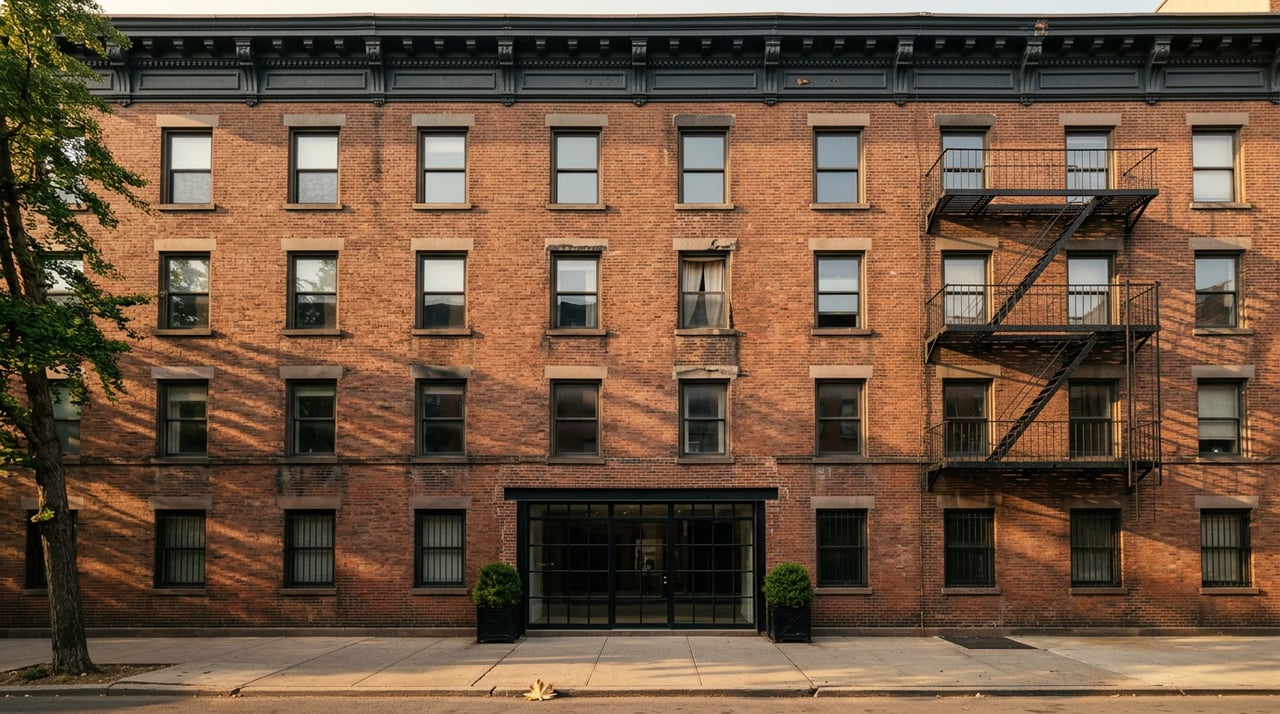
In June, downtown belongs to the Tribeca Festival. By the second week of July, the Lower East Side gets its own tempo back, and this summer that tempo has a pattern worth noticing. New operators aren't spreading out into empty corners of the neighborhood. They're clustering inside, above, and next door to the institutions that were already here.
That is the story of the LES right now. Not a wave of new blocks, but a thickening of the ones you already walk.
The New Museum Has a Restaurant Now, and It Matters
The clearest example sits on Bowery. The renovated New Museum reopened with Oberon, a full restaurant from the team behind June Wine Bar in the West Village. It runs lunch, dinner, and late night until 1 a.m., with a seasonal menu that reads more like a neighborhood bistro than a museum cafe, including fettuccine with peas and chanterelles.
A museum restaurant that stays open until 1 a.m. is not a museum restaurant. It is a downtown dining room that happens to share an address with a Rem Koolhaas building. For a resident, that changes the calculation on a Wednesday night. The Bowery corridor, which usually cedes late dinner traffic to Rivington and Orchard after 10 p.m., now has a reason to hold it.
Two blocks away, Hancock Cafe opened with ties to the artists' collective The Hancock and its frequent pop-up Lev. La Cabra flat whites, a record collection, books, light French bites. Same instinct, smaller footprint. A creative anchor with a coffee counter grafted on.
Rivington Is Quietly Becoming a Cocktail Corridor
If you drew a line down Rivington Street this summer, you would hit an unusual density of new bar programs, all of them betting on the same two-block stretch.
- Tin's, an upcoming cocktail bar, is bringing food from a chef who worked at the Korean tasting menu spot bōm, including a variety of sheng jian bao.
- After Eden is planned as Vietnamese coffee by day and Southeast Asian cocktails by night, from a Ferdinando's Focacceria veteran.
- Leciel, filed for 129 Rivington Street, has proposed an American bistro menu with salmon crudo and beef tartare.
- A cocktail bar tentatively called 98 Rivington, first reported by What Now New York on July 10, 2026, will pair sophisticated drinks with small plates.
Four openings, one street, one summer. The interesting question is not whether they will all survive. Some won't. The interesting question is why operators keep choosing the same three-block radius when the LES has plenty of cheaper storefronts one avenue east or south.
The answer is foot traffic that already exists. A bar on Rivington does not have to teach anyone to come to Rivington. That is a subsidy the operator collects from every neighbor. It also means that if you live within five blocks of Delancey, your walk-to-a-drink radius is materially different in August than it was in April.
Soft Serve, Dominican Home Cooking, and Why Both Are the Same Story
Unnecessary, a new soft-serve shop from the Double Chicken Please team, is doing cocktail-inspired flavors, including a dirty martini soft serve that actually contains vodka. There is also a matcha grasshopper with white chocolate and coconut water for the non-alcoholic column. Two blocks over, El Castillo de Jagua has served mofongo, pernil, and chicharrones de pollo to the neighborhood for more than four decades and is now bookable on Resy for the first time.
These look like opposite stories. One is a novelty concept from a bar group with a Michelin nod. The other is a Dominican institution that predates most of the current storefronts on its block. The link is the platform. Both are betting that discovery, in 2026, runs through the same reservation apps and the same short list of downtown-obsessed publications. A forty-year-old counter and a cocktail soft-serve window now compete for the same Saturday afternoon.
For a resident, that is a useful shift. The old rule was that Resy meant the new place and word-of-mouth meant the old place. That rule is softening.
A quick test of the neighborhood right now: pick any Saturday in July, walk from Seward Park to the New Museum, and count how many storefronts you pass that either opened in the last twelve months or have been there for more than twenty years. The middle tier is thin. That is the LES in 2026.
Hester Street Fair Is Doing Something New Under the Same Name
The Hester Street Fair still runs weekends at Hester and Essex, with a rotating lineup of small-business vendors, artists, and food operators. That much has been true for years. What is new is the geography. The fair took on an 1,800-square-foot storefront with a backyard on East Broadway across from Seward Park, and it continues to run the edible programming for Bryant Park's Monday night summer movie series and Bryant Park Picnics uptown.
Read that carefully. The Hester Street Fair, an outdoor weekend market rooted at one intersection, is now a year-round pop-up landlord on East Broadway and a food operator forty blocks north. Themed weekends still anchor the calendar, from Lobster and Beer to Vintage Day. Alumni of the fair include Petee's Pie Company, Melt Bakery, La Newyorkina, Macaron Parlour, and Arancini Bros, all of which used the market as a launch pad before finding permanent addresses.
For someone who lives here, that changes what a Saturday actually looks like. The fair is no longer a stop. It is a network of stops, and the East Broadway storefront gives you a rainy-day option that did not exist a year ago.
A Weekend, Reconstructed
Enough abstraction. Here is what a July or August weekend in the neighborhood can pull together using only spots named in this post.
Saturday morning starts at the Hester Street Fair between Hester and Essex, from 11 a.m. onward. Coffee and a pastry at Hancock Cafe on the way in or out, depending on which direction you're walking. If a themed weekend lands, plan around it. Lobster and Beer draws a real crowd.
Afternoon drifts toward Bowery. The New Museum is worth an hour on its own, and Oberon handles a late lunch without the reservation friction of a dinner slot. Save the reservation slot for the evening.
Evening picks a lane on Rivington. If Tin's has opened by the time you read this, that is the interesting reservation. If not, El Castillo de Jagua takes walk-ins and now takes bookings, which removes the old friction of standing outside on Rivington waiting for a table.
Sunday is quieter by design. Coffee somewhere with a record player. A slow walk through the fair again, because the vendor list rotates. Dirty martini soft serve at Unnecessary as the last stop before the F train home.
None of that is a discovery. It is a routine. That is the point.
What the Pattern Tells You About the Neighborhood
Three quiet facts, stacked, describe the LES in the summer of 2026 better than any single opening.
First, the highest-profile new restaurant in the neighborhood is inside a museum, not on a corner. That signals a maturing food scene, one where operators want to be tied to a cultural anchor rather than compete for storefront visibility.
Second, four new bar concepts are converging on the same short stretch of Rivington. Concentration, not dispersal. When operators cluster this tightly, they are betting that the block is under-supplied at the price point they are targeting, not that the neighborhood is under-supplied overall.
Third, the LES's longest-running institutions, from the Hester Street Fair to El Castillo de Jagua, are quietly modernizing their distribution. New storefronts, new reservation platforms, new uptown contracts. The old guard is not being displaced. It is expanding.
Put those three together and the neighborhood reads less like a place in transition and more like a place consolidating. For residents, that is good news. Your daily radius is getting denser without getting louder. The same six blocks now hold more of what you need than they did a year ago, and the additions are, on the whole, complementary to what was already working.
If you are thinking about how any of this shows up in the Lower East Side sales or rental market, or whether the density around Bowery, Rivington, and East Broadway is priced into what buyers are paying block by block, that is a longer conversation. Ryan Siciliano covers Downtown Manhattan for the Rubin Team at Douglas Elliman and is happy to have it. Let's Connect.